Behavioral Research Infrastructure

Step into
the Real World

Move beyond the constraints of the laboratory. Care Active equips researchers with IoT devices and AI-powered analytics to capture authentic human behavior — at home, outdoors, and everywhere in between.

View Case Studies → Our Platform
Participants
247
Active Studies
Sleep Onset
22:41
Outdoor Range
4.2 km
The Research Gap

Laboratory findings don't always translate

Traditional research environments introduce observer bias, limit study duration, and fail to capture the complexity of daily living. We close the gap between controlled experiments and real-world validity.

Lab-Based
Artificial environment
Short observation windows
Observer effect bias
Limited ecological validity
Care Active
Natural living spaces
Longitudinal — 6+ months
Passive, unobtrusive capture
IRB-approved, privacy-first
Why Care Active

Research-grade data,
built for the real world

Objective & Continuous

IoT sensors capture behavior passively 24/7, eliminating recall bias and the limitations of self-reporting.

Privacy Protected

On-device data preprocessing ensures participant privacy is preserved. Fully IRB-compliant with no raw location exposure.

Effortless Deployment

Simple device setup designed for non-technical participants. Remote monitoring and management for research teams.

Advanced Analytics

AI-powered pattern detection, longitudinal trend analysis, and exportable data structures ready for statistical tools.

Process

From device to insight

01

Setup

Participants install compact sensors at home or carry wearables. Guided setup requires no technical background.

02

Capture

Devices passively collect location, motion, and behavioral signals continuously across all environments.

03

Process

On-device and cloud AI anonymizes, structures, and enriches raw sensor data into research-ready variables.

04

Analyze

Access dashboards and export tools to integrate data into your analysis pipeline.

Platform Features

Tools built for researchers

Every feature is designed with research workflows in mind — from IRB documentation to publication-ready exports.

Multi-site Participant Dashboard

Monitor enrollment, device status, and data completeness across all participants from one interface.

Privacy-First Data Pipeline

Location abstraction, on-device processing, and configurable data minimization aligned with IRB requirements.

Behavioral Variable Library

Pre-computed variables — activity levels, sleep parameters, mobility metrics — ready to merge with clinical data.

Longitudinal Trend Engine

Detect behavioral change over weeks or months with automated anomaly flagging and cohort comparison tools.

Research Dashboard Live
WEEKLY ACTIVITY — PARTICIPANT COHORT
P-001
78%
P-002
54%
P-003
91%
P-004
43%
P-005
67%
Data Uptime
99.2%
Avg. Study Days
84
Active Devices
32
IRB Protocols
6
Case Studies

Research built on real behavior

Three distinct behavioral sensing methodologies, each designed to unlock new dimensions of ecological research.

Get Started

Ready to move your
research into the field?

Talk to our research team about study design, IRB documentation support, and pilot program availability.

Contact the Research Team →
CASE STUDY — 01 / Indoor · Wearable

Indoor Location &
Activity Analysis

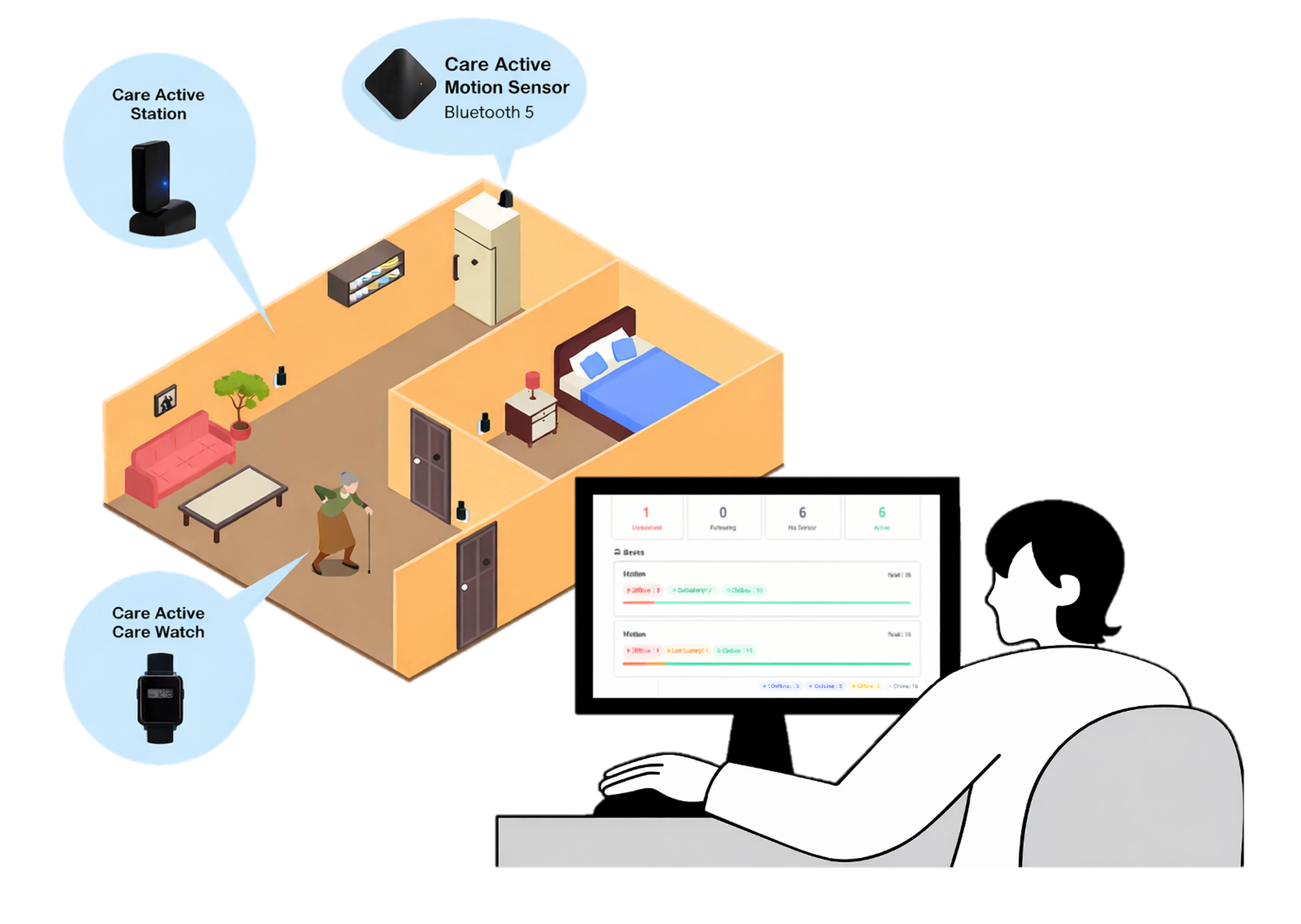
Using wrist-worn devices and room-level positioning infrastructure to capture spatial routines, social synchrony, and longitudinal activity trends in natural home settings.

Care Watch
Bluetooth Station
g3cloud API
LOCATION HEATMAP — PARTICIPANT
LIVING
ROOM
42%
KITCHEN
21%
HALL
8%
STUDY
14%
BEDROOM
38% ×2
BATH
5%
Darker = more time spent · Wk 8 of 24

Research Challenge

Understanding how people actually use their living spaces — and how those patterns shift over time or in response to interventions — is nearly impossible to study in a laboratory. Self-report diaries are unreliable; direct observation is intrusive and impractical at scale.

This case study demonstrates how Care Active's indoor sensing infrastructure enables continuous, passive behavioral monitoring across multi-room environments with no researcher presence required.

How It Works

Participants wear the Care Watch, a lightweight wrist-worn device that communicates with small Bluetooth Stations installed in each room of the home. Signal strength triangulation provides room-level location estimates continuously throughout the day.

Combined with the watch's built-in accelerometer, the system produces a longitudinal record of both where participants spend time and how active they are in each space — without cameras or microphones.

Spatial Resolution
Room-level
No GPS required. Privacy-preserving indoor presence detection.
Capture Continuity
24 / 7
Passive sensing across all waking and sleeping hours.
Battery Life
12 + mo.
Stations require minimal maintenance throughout study duration.

Research Applications

Social Synchrony Analysis. In household studies, overlapping presence data from multiple participants reveals co-location patterns — a proxy for social interaction and relationship dynamics that is otherwise difficult to measure continuously.

Longitudinal Activity Trends. Tracking room-specific activity levels over months enables researchers to detect gradual behavioral change — relevant to aging research, rehabilitation outcomes, and mental health studies.

Spatial Routine Disruption. Deviations from established spatial patterns (e.g., spending significantly less time in the kitchen, or increased nighttime movement) can serve as sensitive behavioral markers in clinical research.

Next Case Study

Privacy-Protected
Geolocation Analysis

Explore how we capture outdoor mobility without exposing participant location data.

View Case Study 02 →
CASE STUDY — 02 / Outdoor · Privacy-First

Privacy-Protected
Geolocation Analysis

Capturing real-world mobility and community engagement through on-device AI processing — rich behavioral indices without ever transmitting identifiable location data.

Smartphone App
On-Device AI
Mobility API
MOBILITY PROFILE — WEEKLY SUMMARY
Home Range 4.2 km
Total Distance 31.7 km
Unique Locations Visited 8 spots
Avg. Dwell Time 47 min
Precise Address Disclosed None ✓

The Privacy Challenge in Outdoor Research

Location data is among the most sensitive personal information a study can collect. Traditional GPS-tracking approaches require storing detailed movement logs on central servers — a significant IRB and participant consent barrier that has historically limited the scope of community-based research.

Care Active solves this with an on-device processing architecture: raw GPS coordinates are processed locally on the participant's smartphone and never transmitted. Only derived, abstract behavioral variables reach the research platform.

Behavioral Variables Derived

Despite never exposing actual places visited, the system generates a comprehensive mobility profile for each participant:

Visit Frequency
Per location
How often a participant returns to recurring destinations, without identifying what those destinations are.
Dwell Time
Per visit
Duration of stays at detected activity clusters — a proxy for social engagement and functional activity.
Life-Space Radius
Daily / Wkly
Maximum distance traveled from home — a validated metric in aging and mobility research.
Total Movement
km / day
Cumulative travel distance as an objective physical activity proxy.
Routine Stability
Score
Consistency of mobility patterns across days — relevant to cognitive and mental health research.
Location Diversity
Entropy
Variety of unique destinations visited — an indicator of social integration and community participation.

IRB Compliance by Design

The system's architecture makes IRB approval substantially easier to obtain. Because precise location data is never collected or stored by the research platform, many of the most common ethical concerns around location tracking are addressed at the infrastructure level — not through policy alone.

Care Active provides documentation templates and technical architecture diagrams specifically designed to support IRB submission for location-based behavioral studies.

Next Case Study

Object Motion &
Routine Analysis

See how a single sensor transforms everyday objects into behavioral instruments.

View Case Study 03 →
CASE STUDY — 03 / Object · Passive Sensing

Object Motion &
Routine Analysis

One compact sensor. Multiple behavioral windows. From sleep architecture to medication adherence, Care Motion turns everyday objects into longitudinal behavioral observation instruments.

Care Motion
Sleep Analytics
Adherence Tracking
SLEEP TIMELINE — LAST 7 NIGHTS
MON
6h 52m
TUE
6h 18m
WED
7h 04m
THU
5h 47m
FRI
7h 28m
██ Asleep  ░ Nighttime exit detected

One Sensor, Multiple Research Lenses

Care Motion is a compact vibration and accelerometry sensor designed to detect motion events from objects it is attached to — without any camera, microphone, or participant interaction. Hanging from a mattress edge or adhered to a cabinet, it becomes a silent, continuous observer.

The same hardware, deployed differently, captures fundamentally distinct behavioral data streams — making it an exceptionally versatile tool across research domains.

Deployment Scenarios

Mattress Deployment
Sleep
Detects bed entry and exit events to compute sleep onset time, wake time, total sleep duration, and number of nocturnal exits.
Refrigerator Door
Eating
Opening frequency and timing patterns provide a proxy for meal regularity and appetite changes over weeks and months.
Medication Bottle
Adherence
Precisely timestamps each interaction with a medication container — an objective, unobtrusive adherence measure for clinical studies.

Why This Matters for Research

Sleep as a behavioral marker. Objective sleep data — collected at home over weeks — is a far richer dataset than actigraphy alone or self-reported sleep diaries. Nighttime exit frequency is particularly relevant to dementia and fall-risk research.

Medication adherence at scale. Non-adherence is one of the most significant confounds in longitudinal clinical trials. Care Motion provides a scalable, non-burdensome way to track whether participants are actually taking medication as prescribed.

Appetite and routine changes. Refrigerator interaction data captures daily rhythm and appetite disruption — variables of high relevance in psychiatric, geriatric, and nutritional research — without any dietary reporting burden on participants.

Explore All Capabilities

Ready to design
your study?

Our research team can help you select the right sensor configuration and data pipeline for your specific research questions.

← Return Home Contact Research Team →